How are generational differences reshaping eCommerce?
What drives a Gen Z shopper and what drives a Boomer has always been different — and the gap only seems to be widening. From how consumers discover and research products to how they experience unboxing and dispose of packaging, generational differences are influencing every stage of the online shopping journey.
For retailers, understanding these distinctions can make a meaningful difference and help them remain competitive in a rapidly evolving market. Insights from the Mondi Group eCommerce Trend Report 2026, based on 6,000 consumers across France, Germany, Poland, Sweden, Türkiye and the UK, reveal how changing expectations are reshaping eCommerce and why a one-size-fits-all approach might no longer be enough.
How do different generations research products online?
The generation divergence begins before a single item is added to a basket. Across three key staged of the research process — identifying suitable products and brands, comparing features and prices, and summarising customer feedback — Gen Z (ages 14–29) and Boomers (ages 62–80) behave very differently1.
The Mondi Group eCommerce Trend Report 2026 shows that:
- Three-quarters (75%) of Gen Z use AI tools to identify products and brands when they are unsure where to start, compared to just 39% of Boomers.
- The same pattern appears when comparing prices across retailers: 75% of Gen Z use AI for this purpose, versus 47% of Boomers.
- When it comes to summarising reviews to avoid reading dozens of individual opinions, 71% of Gen Z rely on AI tools, compared to 40% of Boomers.
The one-fits-all approach fails most visibly here, in the research phase. These findings suggest that retailers need to:
- Consider how their products and brand information are surfaced by AI-powered tools and assistants, not just traditional search engines.
- At the same time, maintaining transparency and easy access to detailed product information remains important for Boomers, who prefer to research and verify information independently, e.g. on a brand’s homepage.

How comfortable are consumers with AI-assisted shopping?
The generational gap becomes more apparent when it comes to handing decisions over to AI to make purchasing decision.
- More than half (53%) of Gen Z shoppers would be comfortable allowing AI to complete a purchase on their behalf without checking all the details, compared to just 24% of Boomers.
- Similarly, 68% of Gen Z would be comfortable with AI adding items to their basket for final approval, versus 35% of Boomers.
However, trust remains a critical factor across all age groups. The vast majority still verify AI recommendations before purchasing, including 79% of Gen Z and 72% of Boomers.
- In addition, six in ten shoppers say they would only allow AI to act on their behalf if it is managed by a brand they already know and trust.
The implication for retailers is clear: AI-powered experiences must be introduced alongside transparency, credibility and consumer control.
How do packaging expectations differ between generations when shopping online?
When it comes to eCommerce packaging, the generational divide becomes even more visible — and commercially significant.
Gen Z places far more value on the emotional dimension of the unboxing experience.
- Nearly eight in ten (79%) say that packaging features such as shape, material, appearance or personalisation contribute to a positive unboxing experience and influence them to buy again — with 27% rating this as very important, up from 17% in 2025.
- They are also more than three times as likely as Boomers to be influenced by personalised messages on packaging (23% vs. 7%).
Boomers (ages 62–80), by contrast, consistently prioritise functionality.
- They are the generation most influenced by the top three practical unboxing factors: appropriately sized packaging (70%), ease of opening (61%), and sustainable external packaging such as paper or cardboard (50%).
These findings highlight the need for retailers to balance functionality and experience.
-
While personalised packaging and premium unboxing experience may strengthen customer loyalty among younger consumers
-
Practical, well-sized, easy-to-open packaging remains a priority for older shoppers
Do generations approach sustainability differently?
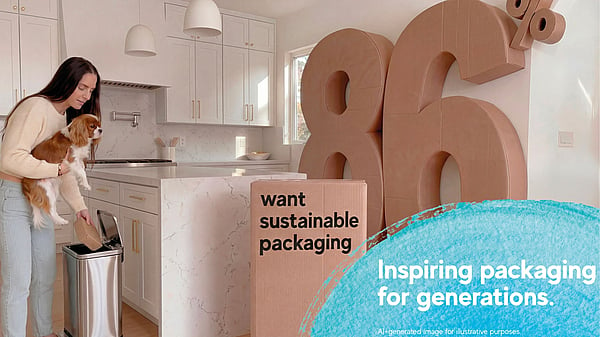
Sustainability is important across all age groups. The report found that approximately 86% of consumers consider sustainable packaging important, regardless of generation. However, consumer behaviour tells a more complex story.
- Six in ten Boomers (59%) place their eCommerce packaging directly into a recycling bin, compared to just 42% of Gen Z consumers.
- Meanwhile, one in five Gen Z shoppers (19%) admit to disposing of packaging they know to is recyclable in general waste — nearly four times the proportion of Boomers (5%).
- A lack of time is one of the key reasons cited, with one in five Gen Z consumers (21%) identifying this as a barrier, a figure seven times higher than among Boomers (3%).
This contradiction is yet another relevant finding in the report. Younger consumers are vocal advocates for sustainability, yet structural and behavioural barriers — complexity, time pressure, unclear labelling — are preventing them from acting on those values.
For retailers and packaging providers, this highlights an important opportunity. Packaging that includes clear disposal instructions, intuitive labelling and easy-to-understand recycling guidance can help bridge the gap between sustainability ambitions and actual consumer behaviour.
What do these insights mean for retailers?
Retailers looking to remain competitive across generational groups could address three implications from the research:
- Design for the AI-assisted shopping journey: With most younger shoppers beginning product discovery through AI tools, retailers need to consider how their products and brand information are surfaced and interpreted by those platforms — not just by traditional search engines.
- Balance functional and emotional packaging needs: eCommerce Packaging must simultaneously deliver practical performance (protective, right-sized, easy to open, easy to return) and experiential value (personalisation, visual appeal, sustainability messaging). The weighting of these priorities should reflect the target audience.
- Make sustainable choices easier to act on: Using recyclable materials is not only part of the solution. Clear, intuitive disposal instructions — perhaps even printed directly on packaging — can help consumers translate sustainability intentions into sustainable actions.
Ultimately, the retailers most likely to succeed will be the those that treat generational insight not simply as a segmentation exercise, but as a design principle that shapes customer journeys, product experiences and packaging strategies.
What insights are included in the Mondi Group eCommerce trend report 2026?
Generational behaviour is just one of the trends reshaping the future of eCommerce.
The Mondi Group eCommerce Trend Report 2026 explores how AI-driven shopping, sustainability expectations customer experience and innovation are converging to redefine the industry.
Based on insights from 6,000 consumers across six European markets, the report provides practical guidance for retailers looking to understand changing shopper behaviours and prepare for future market shifts.
- RetailX 2026, Mondi Group eCommerce Trend Report 2026, "AI's role in product research decisions," pp. 6–8

Transforming market insights into better solutions
Stay ahead of packaging trends in 2026 with our latest eCommerce trend report.
Built on deep, continuous market research, we explore how digital convenience and physical experience are becoming increasingly connected, and how packaging innovation plays a vital role in bringing the two together.
Looking for eCommerce packaging?
Integrated solutions across industries and applications
-
Corrugated boxes for eCommerce
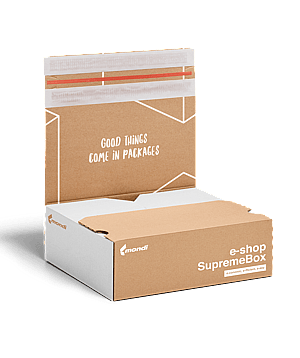
Strong, sustainable corrugated boxes designed for eCommerce. Fast-packing, robust and easy to open, they also provide a great unboxing experience.
-
eCommerce packaging for online grocery shopping
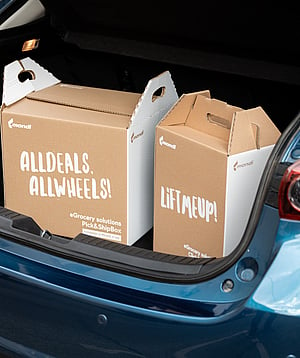
Mondi’s eGrocery offers clever designs with different bottom and closure options as well as inserts and easy opening and carrying solutions.
-
Corrugated mailers
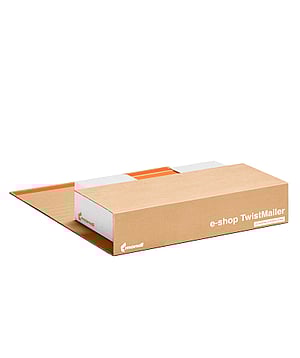
Flexible eCommerce packaging designed to ship less air, cut logistics costs and make packing and returns simple.
-
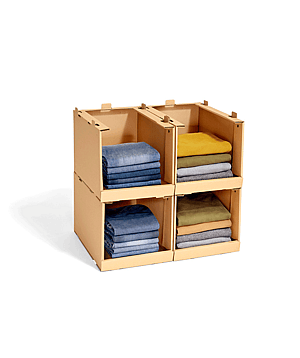
Corrugated shelves
From fashion to logistics, our recyclable corrugated shelves provide lightweight strength, modular flexibility and a corrugated alternative to traditional racking.
-

Fanfold packaging
Sometimes large, bulky goods need something special. That’s when our fanfold packaging is the right solution.
-
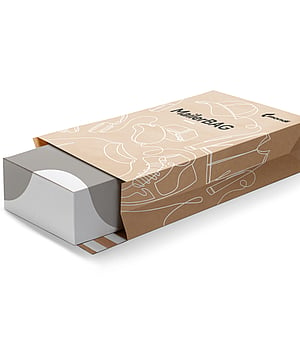
Paper mailers
Our paper mailers are cost-effective, sustainable packaging solutions suitable for a wide range of products – from bulky goods to fragile items.
-
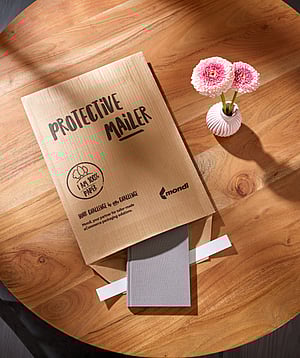
Protective Mailer
Protect your products with a fully recyclable in European paper streams padded mailer that’s strong and easy to use and kinder to the planet.
-
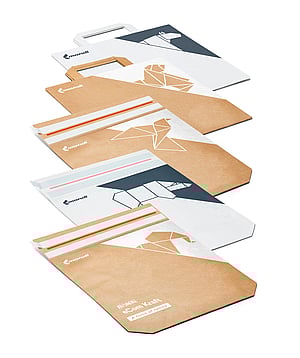
Kraft paper for eCommerce
Our Ad/Vantage and Eco/Vantage eCommerce portfolio includes high quality brown, white and recycled paper grades. Ideal for non-food and food applications with direct food contact certifications. Our Eco/Vantage production can also offer closed loop possibilities for retailers.
-
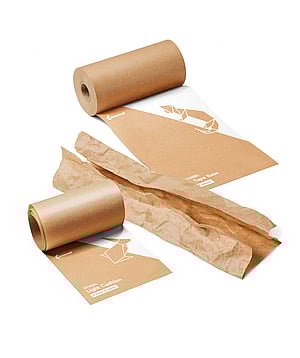
Cushioning & impact-absorbing kraft paper solutions
We offer water-activated tapes, gummed tapes and cushioning paper, with product features designed to suit your specific needs.
-
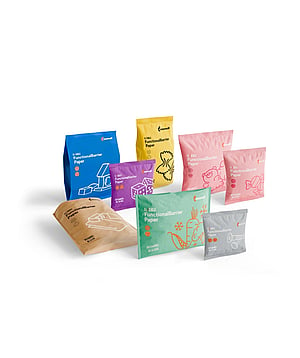
Functional barrier papers
Our re/cycle FunctionalBarrier Paper range is the answer to your sustainable packaging demands. By applying various barrier technologies to paper, we offer fibre‑based alternatives to plastic for HFFS and VFFS applications. From frozen food to eCommerce and everything in between - you name it, we pack it!